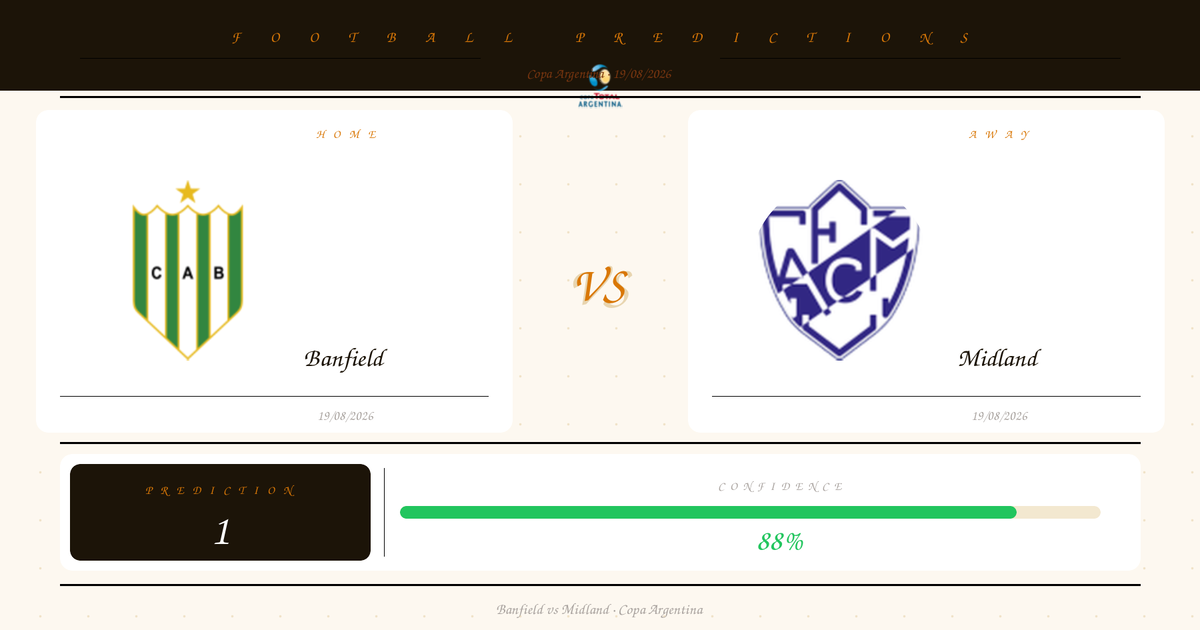
 Banfield
 Midland
Form Analysis and Betting Implications
Banfield's recent form has been inconsistent, with a record of two wins, two losses, and a draw in their last five matches. At home, however, they have shown resilience, securing seven wins out of eleven, scoring an average of 1.45 goals while conceding just 0.91 per match. This solid home form is reflected in their ability to clinch victories even when performance away is less reliable. In contrast, Midland arrives with an upward trajectory, unbeaten in their last five outings, including three wins. Away from home, Midland has managed to balance their performances with three wins, three draws, and three losses, scoring an average of 1.11 goals per game. Their defence has been notably robust, conceding an average of one goal per match. The market appears to price Banfield as favourites largely due to their strong home form, yet Midland's recent improvement suggests they should not be underestimated. Given these dynamics, the odds might not fully account for Midland's capacity to challenge Banfield, indicating potential value in markets related to goal totals rather than outright outcomes.
Market Analysis and Value Opportunities
In the match result market, Banfield is given a 53% chance of winning, closely aligned with their strong home record. The odds of 1.71 suggest an implied probability of 58.48%, slightly overvaluing Banfield given the model's projection. The draw is priced at odds of 3.3, indicating a 30.3% implied probability, against the model's 28%. Meanwhile, Midland's win is undervalued by the market, with odds of 5.6 equating to an implied 17.86%, whereas the model offers them a 19% chance. The over/under 2.5 goals market sees the model predicting a 39% chance of over 2.5 goals, with odds priced at 2.4, translating to 41.67% implied probability, offering no clear edge. However, the over 1.5 goals market displays a model probability of 72% against odds of 1.48, implying a 67.57% probability, thus providing a 4.43% value edge. The BTTS market is priced at odds of 2.15, suggesting a 46.51% probability, with the model predicting 44%, aligning closely with market expectations. Given the respective home and away forms, a Double Chance market favouring Banfield or a draw could also be considered, yet it offers less tangible value compared to the over 1.5 goals market. Therefore, markets with a focus on total goals seem to present the most value in this matchup.
Risk Assessment and Betting Discipline
Assessing the risk factors, Midland's defensive record could pose a threat to an over 1.5 goals bet. With eight clean sheets in their last 20 matches, their defence is capable of stifling opponents. This contrasts with Banfield's more open approach, having failed to score in seven matches but also achieving six clean sheets. A scenario where Midland's defence holds firm could see a lower-scoring affair than predicted. Additionally, the market's odds on other outcomes, such as a draw, suggest some confidence in a tight contest, aligning with Midland's ability to grind out results. However, Banfield's home strength and the model's confidence in goals overrule this concern based on present data. A disciplined betting approach would monitor odds movement closely; if the over 1.5 market shifts above odds of 1.6, re-evaluation for value is recommended. Maintaining a flexible strategy ensures alignment with market dynamics and model insights.
Concluding Value Analysis
The most compelling value bet for this match is the over 1.5 goals market, priced at odds of 1.48. The model's 72% probability against the implied 67.57% probability offers a clear 4.43% value edge. This pick is supported by Banfield's average home scoring rate of 1.45 and Midland's upward form momentum, indicating potential for at least two goals. For those seeking a safer option, the Double Chance market on Banfield or draw provides security, albeit with diminished value. The primary risk to the over 1.5 goals bet lies in Midland's occasionally tight defence, which has achieved multiple clean sheets. Nonetheless, their average concession rate of one goal per match suggests the likelihood of goals remains high. Should odds shift significantly towards the implied probability overtaking the model's, reassessment would be prudent, but as it stands, this market offers a balanced risk-reward profile.